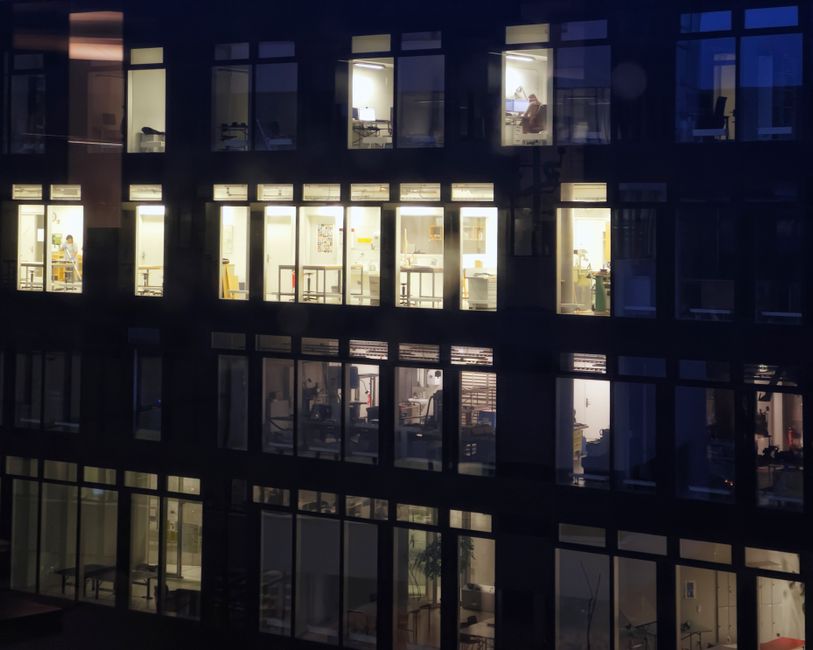
Prague's commercial property market has stalled. Office vacancy rates in the city rose to 9.4 percent in the second quarter of 2026, according to figures compiled by Cushman & Wakefield's Prague office — the highest level since late 2021 — as a string of mid-sized tenants declined to renew leases and hybrid working arrangements continued to hollow out demand for large floor plates in the centre.
That number matters because commercial property has been one of the steadier pillars of Prague's post-pandemic recovery. When office demand softens here, it has knock-on effects across a chain that runs from construction firms in Smíchov to the cafés and dry-cleaners that depend on Monday-to-Friday commuter footfall along Wenceslas Square and Na Příkopě. The timing is awkward. External pressures — energy prices still elevated across Central Europe, tightening credit from Czech banks following three consecutive Czech National Bank rate decisions that left the benchmark rate at 3.75 percent, and a deteriorating export environment linked to weaker German industrial output — are hitting the city's business community from several directions at once.
Jobs Market Cools After Two Years of Tight Supply
The labour market, which was arguably the strongest in the EU just eighteen months ago, is softening faster than most analysts expected. The Prague unemployment rate edged up to 2.9 percent in May 2026, still low by European standards, but the direction of travel is clear. The Czech Statistical Office reported that new job postings in the capital fell 14 percent year-on-year in the first five months of 2026, with the sharpest declines in IT services, logistics, and financial administration — the sectors that drove much of the hiring boom between 2022 and 2024.
Prague 5 and Prague 6 — home to many of the shared-service centres and tech-company regional hubs that expanded aggressively during that period — are seeing the first rounds of quiet restructuring. Several international firms with offices on Radlická and in the BB Centrum complex have reduced headcount through voluntary redundancy schemes rather than formal layoffs, keeping the headline numbers subdued for now. The Czech Employment Service's regional branch in Žižkov reported a 22 percent increase in initial consultations during June compared with the same month last year.
Wages are not collapsing, but real purchasing power is. Average gross monthly pay in Prague stands at roughly CZK 58,400 as of Q1 2026, but with consumer price inflation running at 4.1 percent annually, take-home pay is buying less than it did two years ago. Retailers on Pařížská Street report that foot traffic is down while the Old Town Square tourist economy remains relatively insulated — a divergence that tells its own story about where spending resilience actually sits.
Property Buyers Waiting, Developers Watching
Residential property has its own headaches. The average asking price for an apartment in Prague 2 reached CZK 165,000 per square metre in June 2026, a figure that would have seemed extraordinary five years ago but now feels sticky rather than dynamic — transactions have slowed considerably as mortgage affordability remains stretched at current interest rates. The Prague Development Centre, the city's planning body, approved 3,200 new housing units in the first half of 2026, roughly in line with last year, but developers including Central Group and Skanska Residential are selectively delaying project launches, reading the demand signals carefully.
The city council's Metropolitan Plan, which was supposed to unlock faster permitting across brownfield sites including the Nákladové nádraží Žižkov freight yard redevelopment, is still crawling through implementation. That delay is now measurable in lost investment: two foreign-backed mixed-use developers confirmed to local planning consultants in June that they were pausing site acquisition decisions until permitting timelines became clearer.
For businesses and workers navigating all of this, the practical advice from Prague's Chamber of Commerce is blunt: firms should stress-test cash flows against a scenario where Czech domestic consumption stays flat through the end of 2026, while employees in sectors showing early contraction signals — especially shared services and mid-tier logistics — would do well to refresh skills through programs available at Prague's Job Centre on Štefánikova, which has expanded its retraining capacity by 30 percent since January.