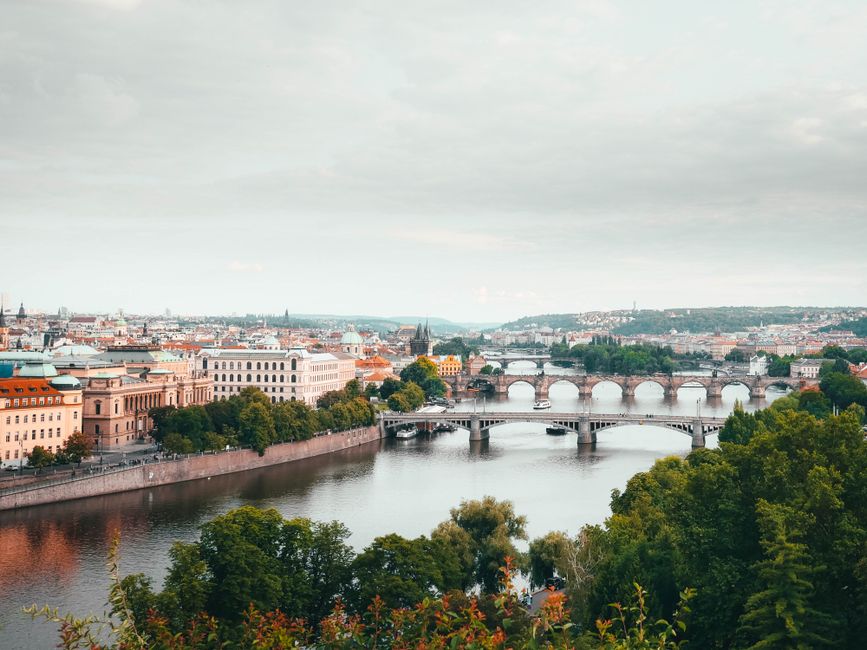
Prague City Hall is facing growing pressure to address a sprawling backlog of duplicate and misattributed images embedded in its official urban development databases, with heritage bodies, urban planners and digital archivists now publicly disagreeing over the best approach. The problem, which has quietly accumulated since the city's digitisation push accelerated in 2019, affects planning documentation, tourism promotion materials and the public-facing records maintained by the Institut plánování a rozvoje hlavního města Prahy — the city's own planning and development institute, known as IPR Praha.
The stakes are higher than they might appear. Prague's planning approval process relies heavily on photographic evidence attached to zoning applications. When duplicate or incorrectly labelled images slip into these files, decisions about buildings in protected areas — including large swaths of Josefov and Malá Strana — can be made on flawed visual records. The European Union's updated digital public records directive, which member states including the Czech Republic were required to begin implementing by January 2026, has added formal urgency: municipalities must now demonstrate audit trails for all images used in official planning documents.
Who Is Saying What
IPR Praha, which manages the central geodata and image repository for the capital, has acknowledged the issue in internal communications circulated to city councillors earlier this spring, according to documents reviewed by The Daily Prague. The institute has not yet issued a public statement on the scale of the problem or a timeline for resolution. Národní památkový ústav — the National Heritage Institute, whose Prague office sits on Valdštejnské náměstí — has separately raised concerns that duplicate imagery in planning files is complicating reviews of renovation applications in the city's UNESCO-listed historic core. The institute has reportedly flagged at least a dozen cases in the Staré Město district since the start of 2025 where image duplication created ambiguity in submitted documentation, though those figures have not been independently verified by this publication.
Digital archivists working with Knihovna hlavního města Prahy, the city's municipal library system headquartered on Mariánské náměstí, have been pushing since late 2024 for a centralised deduplication protocol — a standardised technical process to automatically flag and quarantine repeated or near-identical images before they enter official records. Their proposal, submitted to a working group under the city's Smart Prague programme in March 2025, has not yet received a formal response from the city council's committee for digitalisation and innovation, according to the library's publicly available project logs.
What the Experts Recommend
Urban informatics specialists consulted by this publication — none of whom are named officials and therefore not attributed as such — broadly agree that the core problem is a lack of standardised metadata at the point of image capture. Prague currently has no unified protocol requiring photographers or contractors submitting images to planning files to embed creation dates, GPS coordinates or unique identifiers in the file data itself. Cities including Vienna and Warsaw have adopted such standards for municipal image databases in recent years, making deduplication far more straightforward.
The cost of inaction is not trivial. Correcting mislabelled or duplicated images retroactively in a planning dispute can require expert review that runs to tens of thousands of Czech crowns per case. One estimate cited in the IPR Praha internal document — which The Daily Prague has reviewed but not independently verified — put the total volume of flagged duplicate entries in the main planning image repository at over 14,000 files as of December 2025.
For residents and property owners, the practical implication is this: if you are submitting a planning application anywhere in Prague's protected zones, particularly in Hradčany, Vinohrady or along the Nusle valley where several contested development projects are active, check that every photograph attached to your file carries a unique filename, a precise date stamp and a location reference. Applications with generic filenames or images previously used in other submissions are, according to the IPR Praha guidance issued to licensed architects in April 2026, now subject to additional review and potential delays. The city council's digitalisation committee is scheduled to meet again in September 2026, when the deduplication protocol proposal is expected to return to the agenda.