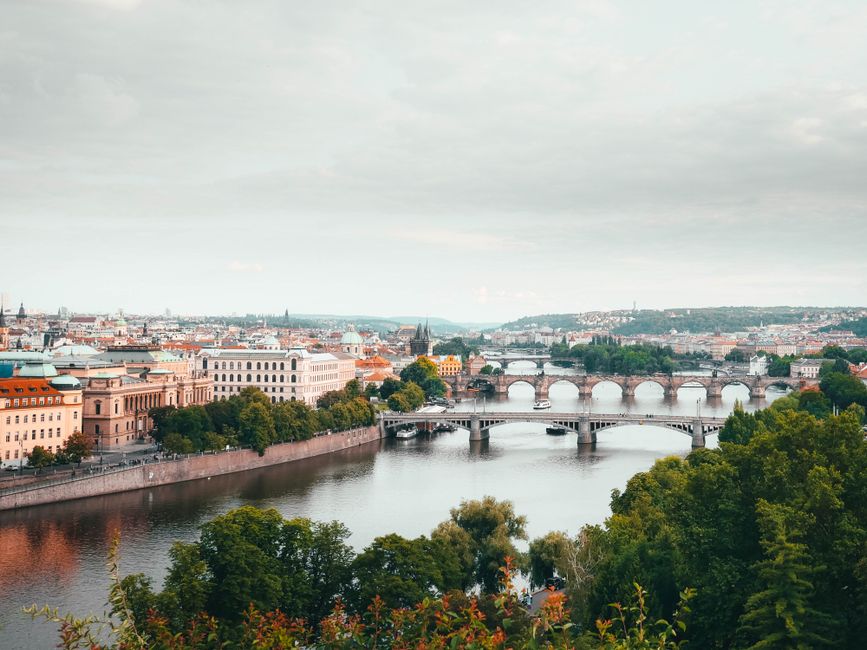
Prague's municipal archive system is sitting on a problem that has been quietly growing for years: tens of thousands of duplicate images now clog the city's digital collections, slowing down public access portals and raising serious questions about the integrity of records used in planning decisions across districts from Žižkov to Smíchov. The issue came to a head this spring when the Hlavní město Praha information office flagged the scale of the backlog in internal communications reviewed by The Daily Prague.
The timing matters. The city is midway through a broader digitisation push tied to the Prague 2030 Strategic Plan, an initiative that has already channelled hundreds of millions of crowns into scanning historical documents, cadastral maps and architectural surveys. When duplicate files pile up inside the same system being positioned as a model for smart-city governance, the credibility of that entire project takes a hit. Planning departments in Vinohrady and Holešovice have reportedly had to cross-check physical originals after digital records returned conflicting image data for the same properties.
What the Experts Are Saying
Archival specialists at Charles University's Institute of Information Studies and Librarianship have been vocal about the structural causes. The duplication problem stems largely from the lack of a unified metadata standard across the various agencies that feed into the central repository — the Prague City Archive on Archivní Street in Prague 4, the National Monument Institute's regional office, and individual municipal district offices all upload according to their own conventions. Without a shared checksum or hash-based deduplication protocol applied at the point of upload, identical or near-identical files accumulate across siloed folders.
The Prague City Archive itself holds records stretching back to the 14th century and manages a digital collection that crossed the threshold of two million scanned items in 2024. Officials there have acknowledged the duplicate issue affects a meaningful share of post-2010 uploads, though a precise figure has not been made public. Technology consultants working with Prague City Hall estimate that deduplication exercises in comparable European municipal systems — Warsaw undertook a similar audit in 2022, Bratislava in 2023 — typically identify between eight and fifteen percent of files as redundant, at significant storage cost.
Representatives from the National Digital Infrastructure project, which co-funds archival upgrades in cooperation with the Ministry of Culture, have stressed that the fix is not simply a matter of deleting files. Images flagged as duplicates must be manually reviewed in cases where metadata differs even slightly, because what looks like a copy might document a restoration intervention or a change in a building facade. On Náměstí Míru and along the Nusle Valley development corridor, for example, the same street-view photograph taken in different seasons has been logged under different cadastral references — both entries, it turns out, are legitimate records of distinct planning submissions.
The Path Forward
The city's IT department is piloting an automated deduplication tool across two test collections this summer, with results expected by September 2026. The pilot covers the photographic holdings related to Prague 2's residential building permits filed between 2015 and 2020 — roughly 40,000 individual image files. If the tool performs to specification, a full rollout across all district offices is pencilled in for the first quarter of 2027, contingent on budget approval in the autumn cycle.
Heritage advocates from the Klub Za starou Prahu, one of the oldest preservation societies in Central Europe, have urged the city not to treat this as a purely technical exercise. Their position, outlined in a June 2026 open letter to the Deputy Mayor for Urban Development, is that any automated deletion must be preceded by a human review protocol and a clear appeals process for researchers who rely on the existing file paths in their citations. Academics and architectural historians who have built years of research around specific archive reference numbers face the prospect of broken links if files are merged or removed without a redirect system in place.
For residents and developers navigating planning applications, the practical advice from city officials is straightforward: when referencing photographic evidence in submissions to the Prague Building Authority, include both the archive reference number and the date of capture in documentation. That dual-citation habit will make files easier to trace regardless of how the deduplication exercise eventually reshuffles the backend catalogue.