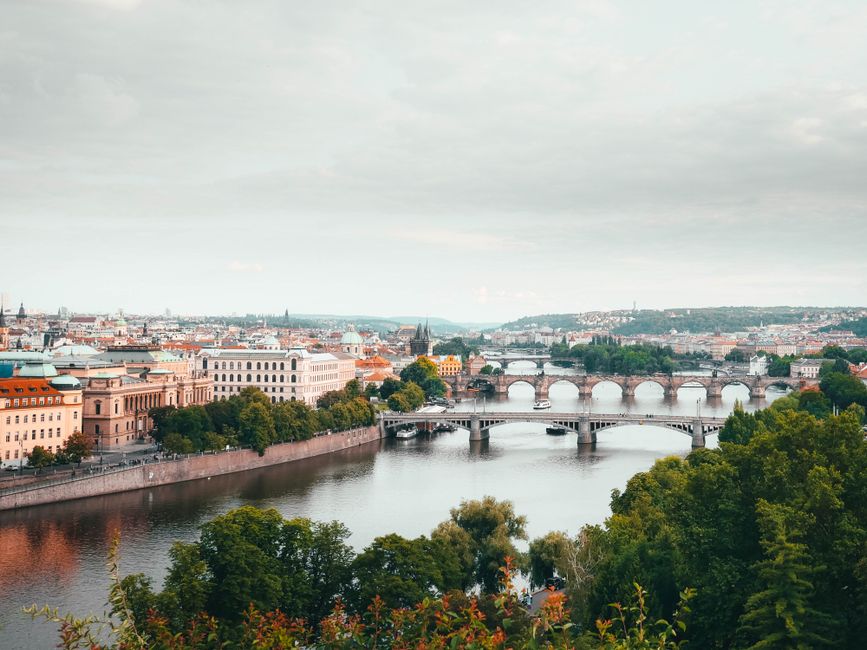
Prague's municipal digital archive holds more than 1.4 million photographs documenting the city's built environment, from the Gothic spires of Staré Město to the socialist-era housing blocks of Jižní Město. A growing technical problem is threatening the usefulness of that collection: duplicate images — sometimes dozens of near-identical files for a single building or street — have accumulated across multiple platforms, and no unified deduplication programme has yet been adopted by the city.
The issue has come into sharper focus this summer as Prague City Hall advances its Smart Prague 2030 strategy, which includes centralising urban data systems across all 22 municipal districts. Archivists and urban data specialists say that without resolving the duplicate image backlog first, the consolidation effort risks embedding the problem into a newer and more expensive infrastructure.
What Officials and Institutions Are Saying
The Prague Institute of Planning and Development, known by its Czech abbreviation IPR Praha, has flagged the duplication problem in internal working documents circulated to city councillors ahead of the autumn budget session. IPR Praha coordinates spatial data for the entire metropolitan area from its offices near náměstí Republiky, and its digital mapping teams are among those most directly affected. Staff there have noted publicly, at open planning forums, that redundant image files are driving up storage costs and complicating searches in the GIS-linked photo database.
The City of Prague Archives, housed on Archivní Street in Holešovice, manages a separate but overlapping trove of historical imagery. Officials at the institution have previously described the challenge of harmonising their catalogue with those held by individual district offices, each of which has historically maintained its own photo records. The lack of a shared deduplication standard means that a photograph of, say, a heritage building on Malostranské náměstí may exist in four different formats across four different servers, each slightly cropped or colour-corrected.
Prague's data governance coordinator at the Department of Digital Services has told planning committees that the city is evaluating at least three automated deduplication software solutions, with a procurement decision expected before the end of the third quarter of 2026. The evaluation includes tools that use perceptual hashing — a technique that identifies visually similar images even when file names or metadata differ — rather than simple file-size comparisons, which experts say would miss a large proportion of true duplicates.
The Scale of the Problem and What Comes Next
A review conducted by IPR Praha in early 2026 estimated that between 18 and 25 percent of images stored across the city's interconnected digital systems are functional duplicates. On a repository of 1.4 million files, that implies anywhere from 250,000 to 350,000 redundant records consuming server capacity. Storage is not cheap: enterprise-grade archival hosting of the type used by Prague's municipal systems currently runs at roughly 4,200 Czech crowns per terabyte per year under the city's existing contracts, according to procurement documents published on the city's official procurement portal.
Heritage professionals have a separate concern beyond cost. When a researcher, journalist or architect queries the archive for images of a specific Vinohrady apartment block or a pre-war shopfront on Wenceslas Square, duplicate results dilute search relevance and slow retrieval. The Prague Heritage Foundation, which works with the National Monument Institute on documentation of listed structures, has pointed out that researchers sometimes unknowingly cite duplicate images as distinct historical sources — a problem with real consequences for restoration decisions.
The Smart Prague 2030 working group is scheduled to present its data infrastructure recommendations to the City Council in September 2026. Specialists in the field say the most practical near-term step is a phased deduplication audit beginning with the most frequently accessed collections — those covering Hradčany, Josefov and the historic core — before expanding outward to district-level holdings. That sequencing, they argue, would deliver measurable improvements to the most-used public-facing portals while the broader procurement process runs its course. For residents and researchers alike, the practical upshot is that the archive's public search interface, currently accessible through the city's geoportal, may remain patchy until at least mid-2027.